
Walter Ernest Frank Messenger
10435 Private
18th (Queen Mary's Own) Hussars
K.I.A. Saturday, 17th October 1914
Remembered with Honour, Trois Arbres Cemetery, Steenwerck, Nord, France, Plot: II O 36
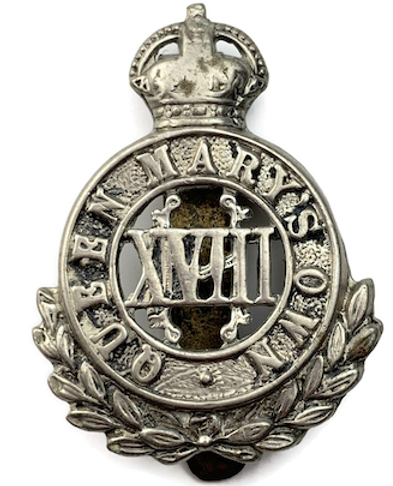
18th Hussars Cap Badge WW1
Known as ‘Boy’ to his family, Frank Messenger was killed in action on 17th October 1914. He was born in Hemel Hempstead on 12th October 1896 to Walter (William) and Cicely who lived in London Road, Boxmoor. Frank had four brothers and two sisters, one of whom, Nellie had died in her early teens. His older brother Rupert enlisted in the Army Service Corps (Motor Transport) and survived the conflict.
Frank started school in 1903 at Boxmoor Junior, Middle & Infant School shortly after his sixth birthday and the day after his brother Rupert had been enrolled. His school records indicate that the family relocated to the Watford area in 1905 and Frank moved first to Bushey British School, followed by Beechen Grove Board School in the town. Beechen Grove school stood in Red Lion Yard and was unusual in having a a pub next door. The Messengers were living at 36 Chester Street in Watford at the time, just a stone’s throw from Watford FC’s old Cassio Road ground and around the corner from their current home at Vicarage Road.
In 1908 Frank’s father Walter had moved the family back to Hemel Hempstead and they settled in Moor End, Boxmoor. Two years later Frank had moved school once more, this time to Bourne End where his formal education concluded in 1911 and he left to begin work for his father.
Walter was a rope and tarpaulin maker and Frank joined his father to learn the trade in 1912. Rope making was carried out on an industrial scale at ports in the UK, but smaller towns would also have had a local rope-maker, and most farms would have made their own rope. The materials were always more expensive than the labour and the Messengers would have supplied rope for plough lines, carts and halters as well as clothes lines and skipping ropes. Frank did not stay long in his father’s employ and in early 1913 aged sixteen he joined the Territorial Artillery and a few months later on 20th August he enlisted as a professional soldier with the 18th (Queen Mary’s Own) Hussars.
The 18th (Queen Mary’s Own) Hussars was a cavalry regiment of the British Army named after Queen Mary in 1910 to mark her coronation as Queen Consort. (Her mother Princess Mary, Duchess of Teck, had officially opened the new West Hertfordshire Infirmary building in 1877, now Hemel Hempstead General Hospital).
The 18th Hussars were based at Tidworth at the outbreak of war and just twelve days later embarked for France as part of the 2nd Cavalry Brigade in the 1st Cavalry Division.
By October 1914 the battalion was at Neuve Eglise (Nieuwkerke, Belgium) about 13kms south-west of Ypres, engaged in The Battle of the Yser. On the 17th October the 18th Hussars war diary records the issue of bayonets to the Regiment for the first time, no doubt in anticipation of close combat with the enemy. Additionally, casualties for this day are listed as; "1 officer and 8 men wounded, 6 men killed and 1 man missing." Frank Messenger was amongst the men killed. Frank had been a soldier for just under fourteen months and had been in France for only sixty-six days when he was killed.
His father Walter received a letter from his son's Commanding Officer which described how he had died and this was published in the Hemel Gazette shortly afterwards.
Following the Armistice in 1918, over 700 graves were relocated and interred in Trois Arbres Cemetery, Steenwerck from the battlefields of Steenwerck, Nieppe, Bailleul and Neuve-Eglise. Frank’s grave was amongst these and he is now Remembered with Honour in Trois Arbres Cemetery, Steenwerck, Nord, France where he is interred in Plot: II O 36.
Frank was only 18 years old when he was killed.
He was eligible for the 1914-15 Star, the British War Medal and the Allied Victory Medal.


