Alan Chadwick Iliff
Sub-Lieutenant
Nelson Bn. R.N. Div., Royal Naval Volunteer Reserve
Died of Wounds Sunday, 20th June 1915
Remembered with Honour, Skew Bridge Cemetery, Canakkale, Turkey, Plot: II E 1
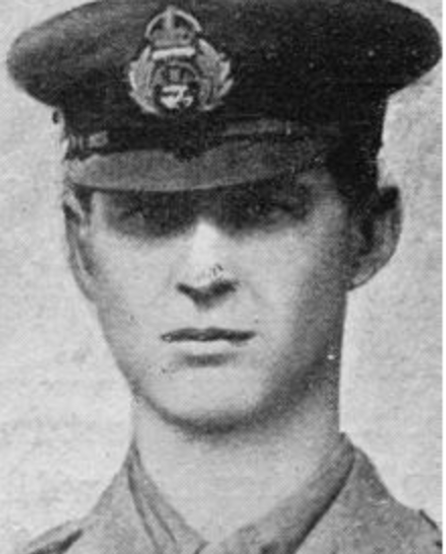
Alan Chadwick Iliff c1914
Alan Chadwick Iliff was born in Camberwell, East Dulwich, London on Wednesday, 25th March 1885, the younger son of Captain Charles Iliff and Helen Isabella Wilkinson. He had two older siblings, Charles Wilkinson and Elsie Cheyne. Alan’s father Charles was a Master Mariner and records show that he was often away at sea and as a result the family moved frequently during Alan’s younger years, often boarding or with relatives.
In 1891 when Alan was six years old, he lived with his mother, brother and sister at 1 Ribble Terrace in Settle, Yorkshire where they were boarding. The three children were at school and Alan’s mother Helen is listed as “Living on own means”. Both Alan and his older brother Charles attended Giggleswick in Settle, an independent school founded in 1499. A few years later Alan had moved to Royal St Anne’s school in Redhill, Surrey where he completed his education.
By 1901 he was living at 32 Egerton Road, Chorlton-cum-Hardy, Manchester with his mother, brother and sister and aged sixteen, worked as a Printers Apprentice. His brother Charles was a Stationery Traveller, and this was the trade that would eventually bring both young men to Hemel Hempstead.
Whilst living in Manchester, Alan’s sporting talents were put to good use as a member of the Adelphi Lads Club in nearby Salford and as an oarsman with Agecroft Rowing Club in Pendleton. Alan excelled at both hockey and rowing and represented Lancashire and in later years, Hertfordshire at the former sport.
The Adelphi Lads Club was founded in 1888 to provide for the needs of lads from the deprived industrial districts of Adelphi and Greengate. However, it soon grew to include boys from all backgrounds who were attracted by the many organised sports it offered including; football, rugby, hockey, cricket, boxing and gymnastics.1080 Adelphi lads enlisted in the Great War and Alan was one of 207 who died. The club eventually closed in 2013 after 125 years of existence.
Alan’s father Charles died at sea on the 22nd February 1903 and was subsequently buried in Brisbane, Australia without any of his family in attendance. His father bequeathed a substantial inheritance to Alan’s mother Helen, who received a settlement of £5083, the equivalent to £432,000 today.
In 1911, both Alan and his brother Charles were living at 10 Charles Street, Berkhamsted were they boarded with Mr Harry Holloway, who is described as a ‘House Decorator and Registrar of Births and Deaths’. They both worked as Stationery Manufacturers, Charles as an Assistant Manager and Alan as a Clerk, in a small business in Berkhamsted.
At the outbreak of war Alan enlisted with the Royal Naval Volunteer Reserve, having already seen some naval service before this date working his passage on tramp steamers on a number of occasions. Despite the offer of other commissions, he preferred to enlist as an Ordinary Seaman on 9th September 1914 and was assigned to Drake Battalion of the Royal Naval Division (RND).
The RND was made up of the four existing infantry battalions of the old Marine Brigade comprising the Royal Marine Light Infantry and Royal Marine Artillery. In August 1914 Churchill the First Lord of the Admiralty, decided to embody two more naval brigades with surplus men of the Naval Reserve, to join with the Marine Brigade to produce a composite Royal Naval Division. It formed into the 1st and 2nd Marine Brigades and the Battalions took the names of famous sailors; Drake, Benbow, Hawke, Collingwood, Nelson, Howe, Hood and Anson.
Alan underwent basic training at “HMS Crystal Palace” the London land based training establishment for the RND. During World War One the Crystal Palace and grounds were closed to the public and designated as the Royal Naval Shore Station “HMS Victory” but soon became known as “HMS Crystal Palace” .
He rose rapidly through the ranks promoted Leading Seaman on the 21st October 1914, then Petty Officer on the 23rd December of the same year. Finally, he was discharged from 1st Battalion and appointed to ‘A’ Company, 3rd (Benbow) Battalion in the 1st Brigade RND, when he was gazetted Sub-Lieutenant on the 10th March 1915.
By April 1915 the RND was part of the Mediterranean Expeditionary Force preparing for the Gallipoli campaign and Alan sailed for the Dardanelles in May 1915. The RND suffered significant casualties during the landings at Gallipoli and in subsequent actions during April and May. As a result, the Battalions where reformed and Alan was transferred to Nelson Battalion in the 1st Brigade on 12th June after landing at Cape Helles.
He saw action throughout June at the Third Battle of Krithia and during various subsequent engagements on the Peninsula. On 20th June 1915 he was wounded whilst once again leading his men against the enemy and he subsequently died of his wounds later the same day. His death revealed the extent of the respect that his men had for Alan and two letters received by his brother Charles in July 1915 testified to this fact. The letters came from men who had been under his command with Benbow Battalion and not only spoke of his bravery but describe their regret at losing their officer when that he had been transferred to Nelson Battalion. In all 39 men signed the two letters.
They described Alan as “one of the most manly and masterful characters” and spoke of “his willingness to go with his men through anything”. The letters were published in the Hemel Gazette in July.
Alan is Remembered with Honour at Skew Bridge Cemetery, Canakkale, Turkey, where he is interred in Plot: II E 1. The inscription on his headstone, requested by his brother Charles, reads: “SON OF CAPTAIN CHARLES ILIFF, SUNDERLAND”
He is also commemorated in the Books of Remembrance (now lost) for the Adelphi Lads Club in Salford.
Alan was 30 years old when he died.
He was eligible for the 1914-15 Star, the British War Medal and the Allied Victory Medal.


