Harry Holden
63890 Gunner
123rd Battery, Royal Field Artillery
Killed in Action Wednesday, 5th May 1915
Remembered with Honour, Hooge Crater Cemetery, West-Vlaanderen, Belgium, Grave: XVII. A. 12.
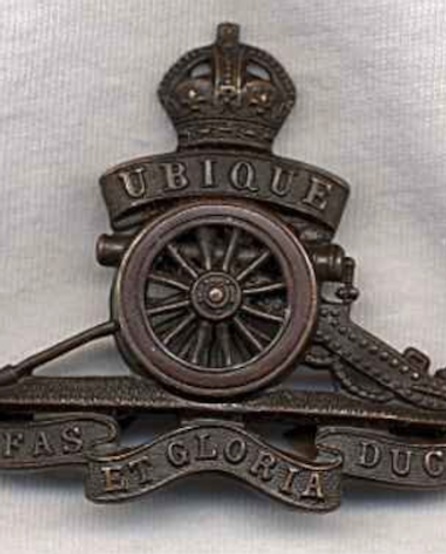
Royal Field Artillery Crest
Henry Holden, known as Harry, was born on the 4th September 1895 to John and Elizabeth, their third child and first son. The location of his birth is a little confused with the 1901 Census recording Boxmoor as his birthplace, whilst on enlistment in the Army, Harry gives his place of birth as Kings Langley. Harry had two older sisters, Dora and Jenny and a younger brother Charles.
All four children were born in or near Hemel Hempstead, but the family had moved to South Norwood near Croydon by 1901. Harry joined his sister Jenny at Whitehorse Manor Infants School in Croydon on the 24th April 1899, at the age of three years and seven months, shortly after his family had moved to the area. Ten years later on the 14th March 1909, he completed his education and left Whitehorse Manor to start work as a Butcher’s Errand Boy at the age of fourteen.
The photograph below shows the original school as it is today and includes the school war memorial which commemorates 117 pupils who gave their lives in the Great War.
Harry enlisted as a regular soldier with the Royal Field Artillery (RFA) sometime before the outbreak of the Great War. Records show that he attested in London and joined the 123rd Battery RFA. This was a unit of Britain’s pre-war regular army and was part of the 28th Brigade RFA. It Comprised 122nd, 123rd and 124th Batteries, under command of the 5th Infantry Division. In August 1914 it mobilised and was sent to the Continent with the British Expeditionary Force, where it saw service throughout the war.
The 28th Brigade was at Dundalk in Ireland at the outbreak of war and mobilised on 17th August 1914, embarking from Belfast on the “SS Mesaba” and sailing "in perfect weather". Disembarkation at [Le] Havre in France took place two days later on the 19th August. As part of the BEF Harry saw action in most of the major engagements during 1914 beginning at Le Cateau, where the Brigade suffered it’s first casualties due to heavy shelling by the enemy.
He survived the Battles of the Marne and Aisne, La Bassee and Messines and the First Battle of Ypres. Following a winter spent mainly in reserve, he then saw action in The Second Battle of Ypres before he fell on 5th May 1915 at Hill 60, the fourth Hemel Hempstead man to die there.
The War Diaries did not record Harry’s death, and whilst it is not clear how he was killed, it was in all likelihood from the German gas attack on the morning of 5th May. The Battalion War Diaries offer a description of the attacks and the almost non-stop bombardment by both sides from 9am to 11pm, and the failed efforts to retake Hill 60 by the British: "Wednesday May 5th……At 8.40am all batteries opened rapid fire around the front at Hill 60, as Germans have attacked and are using “gas”. 9am Learn that Germans have captured “60”. Turn guns on to the crest of the hill..."
During that day there was continued firing of varying intensity and some of the trenches were recaptured from the Germans. However, by late evening news that Hill 60 had not been retaken by the British filtered through: "May 5th 11pm Hear attack has failed owing to concentrated German fire from all directions”. Harry was one of 3,100 casualties out of the 5th Division at Hill 60 between the 1st and 7th May.
Harry is Remembered with Honour at Hooge Crater Cemetery, West-Vlaanderen, Belgium where he is interred in Grave: XVII. A. 12.
Harry was only 20 years old when he was killed.
He was eligible for the 1914-15 Star, the British War Medal and the Allied Victory Medal.


