Henry George
13616 Private
1st Bn., Bedfordshire Regiment
Died of Wounds Saturday, 5th June 1915
Remembered with Honour, Hemel Hempstead (Heath Lane) Cemetery, United Kingdom, Grave W.27.
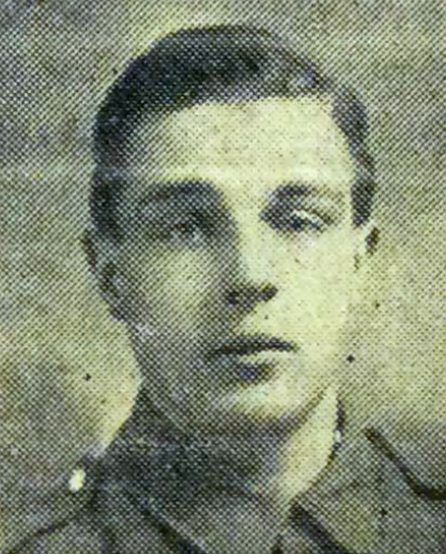
Henry George c 1914
Henry (Harry) George was born on Wednesday, 2nd May 1894 in his Uncle Tom’s home at 56 Cotterells in Hemel Hempstead and baptised later the same year on Friday, 23rd November at St Paul’s Church. His mother Emma was twenty-eight years old when Harry was born and worked as a Charwoman, having previously been a Straw Plaiter, a dying occupation in the 1890’s. Harry’s birth certificate does not reveal the identity of his father and he was raised by his Grandmother and Aunts. His mother’s occupation as a domestic servant meant that she ‘lived in’ at her employer’s home and depended on her family to help with Harry’s upbringing. Emma’s employer was in fact Cecil Sanguinetti, the Managing Director and Chairman of the British Paper Company in Frogmore, Apsley End.
In 1901, when Harry was six years old he was living with his grandmother Mary at 39 Chapel Street in Hemel Hempstead whilst his mother was at the Sanguinetti home in St John’s Road, Boxmoor. The difference in the households could hardly have been more different and the 1901 census records that Harry’s Grandmother and one of his Aunts were receiving ’Parish Relief’, the equivalent of the modern benefits system, so clearly in impoverished circumstances.
Nevertheless, Harry grew to manhood and took up employment at the Frogmore Paper Mills where he was a General Labourer in 1911, and living with his Uncle Tom still at 56 Cotterells. Tom was a Blacksmith making agricultural implements, a job he did for over fifty years in the employ of Davis & Bailey at the Boxmoor Iron Works, situated in Marlowes (in the vicinity of ‘Bank Court’ today).
Harry was still working at Frogmore Mill aged twenty and had met Winifred Carpenter who worked in the Envelope Department at nearby John Dickinson. Winnie was also from Boxmoor and whilst it is not known how she met Harry, it may have been through St John’s Church in Boxmoor, where Harry was an active member. He had also pledged himself to the Church of England Temperance Society (CETS), a charity which promoted abstinence from alcohol. By the time war broke out in 1914 Harry and Winnie were sweethearts, a fact subsequently recorded in Harry’s extensive obituary published in the Hemel Gazette.
Harry was a popular young man for his Church work and his willingness to help with events such as concerts and social functions. He was described as having a cheerful nature which made him made a host of friends, and at Frogmore Mills, where he was employed he was esteemed and respected by all.
It is no surprise then that Harry was amongst the earliest recruits to the colours in August 1914, when he attested at Watford and enlisted with the 3rd Battalion Bedfordshire Regiment. Initially sent to Landguard Fort in Felixstowe to undergo basic training, Harry was subsequently posted to the 1st Battalion Bedfords in early March the following year and sent to France on 23rd March 1915.
He joined the Battalion near Ypres on the 28th March and was soon in the trenches during April, including the appalling actions at Hill 60 where the Bedfords suffered significant casualties as recorded in the war diaries: "Almost 100 Other Ranks were also killed between the 18th and 21st with several hundred more wounded.” Having survived the initial ordeals at Hill 60, Harry then experienced the horror of "asphyxiating gas" attacks by the Germans as they retook the Hill on 5th May, where skirmishes continued for two more days.
Harry was wounded in a leg by shrapnel on the final day of action around Hill 60 and when his picture was published by the Gazette later in the year it recorded the date as the 7th May 1915.
He was evacuated to a base hospital at Boulougne where he remained for two weeks. His wounding was reported in the Gazette.
Harry was subsequently transferred to the military hospital in Sobraon Barracks at Colchester. This was designated ‘UK Home Central Hospital’ for the admission of servicemen direct from disembarkation.
Initially, Harry’s prospects for recovery seemed good, a view confirmed from the nature of his cheerful letters home. However, his condition deteriorated and on Saturday 5th June 1915 he underwent urgent surgery to amputate his injured leg, his only chance of survival. He rallied briefly following the operation but sadly died later the same day.
Following his death, the Hemel Gazette published an unusually long obituary (some twenty-one column inches), which included a poem dedicated to his memory by the Reverend Thomas Tiplady. The Rev. Tiplady was a chaplain to the British Expeditionary force, a prolific author, poet and hymn writer and many of his poems dedicated to the fallen appeared in the Gazette during the Great War. He preached at Marlowes Methodist Church.
The Gazette report also recorded details of his funeral service, attendees and floral tributes. Typically, large obituary’s in the Gazette were reserved for notable public figures, so Harry’s is an indication of his popularity and the esteem in which he was held by family, friends, his employer and work colleagues. Additionally, he was the first of the fallen to ‘come home’ and he was buried with full military honours on Wednesday 9th June 1915.
Harry is Remembered with Honour at Hemel Hempstead (Heath Lane) Cemetery, where he is interred in Grave W.27.
Harry was 21 years old when he died.
He was eligible for the 1914-15 Star, the British War Medal and the Allied Victory Medal.


