
Arthur Thomas Cook
25477 Corporal
7th Bn., Northamptonshire Regiment
Killed in Action Monday, 25th March 1918
Remembered with Honour Pargny British Cemetery, Somme, France, Grave IV. C. 7.
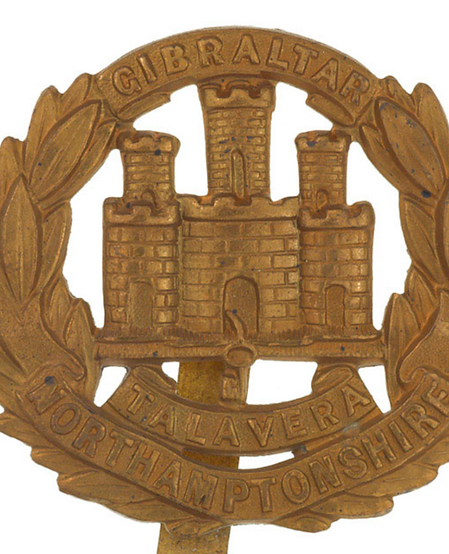
Northamptonshire Regiment Cap Badge WW1
Arthur Thomas Cook was born in Borden, near Sittingbourne in Kent in early 1888, the first child of Eli Cook and Mary Ann Bowles. Eli and Mary Ann had a large family of ten children together and Arthur’s younger siblings were: Hilda, Etty (Hetty), Frank, Charles, Phillis, Dorothy, Victor and Caroline. In 1891, the Cook family lived on Key Street, Borden in Kent next door to the "British Queen" public house. Arthur’s father Eli worked as a "Gardener" and was recorded as a "Domestic Servant", so presumably his situation was in a large private property nearby.
Ten years later Eli had moved his family a short distance to a larger home in Bobbing, Sittingbourne where Arthur attended the local school. By this time, Eli had added the job of a "Coachman" to his gardening work and it is likely that when young Arthur left school in 1901, he followed his father into domestic service. By 1907, Arthur had moved to Hemel Hempstead to take up a position as a "Butler" in service to Percy Christopherson the Headmaster at Lockers Park School. Percy Christopherson was Headmaster of the school between 1902 and 1918 and had played rugby for England and first class cricketer for Kent and Sussex. In 1912 he became a Trustee of the Boxmoor Trust, a position he held until his death in 1921.
Whilst working at Lockers Park, Arthur met Ada Elizabeth Wallace, a native of Kettering in Northamptonshire. Ada had come to Hemel Hempstead in 1912 to work as a "Housemaid" at the school and she and Arthur soon became sweethearts. In the summer of 1914 Arthur and Ada returned to her home town and married at St James’ Church in Thrapston.
Arthur volunteered under the Military Service Act in June 1916 and attested at Hemel Hempstead, where he enlisted with the Northamptonshire Regiment, his wife’s home county regiment. He left for basic training before being sent to France sometime in early 1917, when he was posted to the 7th (Service) Battalion Northants. He was soon in action and fought in the Battle of Vimy Ridge in early April 1917 followed two months later by the Battle of Messines. He survived these encounters before moving to Belgium with his unit where it took up positions north of Ypres in late July.
On the 31st July he was in action again when he fought in the Battle of Pilckem Ridge and then at Langemarck in mid-August. These battles were both phases of the Third Battle of Ypres where the Battalion suffered 250 casualties before it moved back to France in September to the vicinity of Cambrai. In early 1918 the 7th Northants were engaged in training or formed working parties. In the second week of March, Arthur was granted some home leave and he returned to England visiting Hemel Hempstead and Kettering to see his wife and friends. He returned to his unit on the 18th March and just a few days later fought in the Battle of St Quentin. On the 25th March the unit took part in an abortive French counter-attack, which resulted in the Germans out flanking the 7th Northants and inflicting significant casualties, before the battalion was able to withdraw. Arthur was one of the unfortunate casualties.
He was killed on Monday, 25th March 1918.
His death was reported in the Hemel Gazette.
Arthur is Remembered with Honour in Pargny British Cemetery, Somme, France, where he is interred in Grave IV. C. 7. The inscription on his headstone, requested by his wife Ada, reads: “PEACE PERFECT PEACE”
He was 30 years old when he died.
Arthur was eligible for the British War Medal and the Allied Victory Medal.


