
Charles John Hitchcock
369634 Sapper
"J" Depot Coy., Royal Engineers
Drowned at Sea, Thursday, 10th October 1918
Remembered with Honour, Kirkcudbright (St. Cuthbert) Old Churchyard, Kirkcudbrightshire, Scotland, Special Plot 4
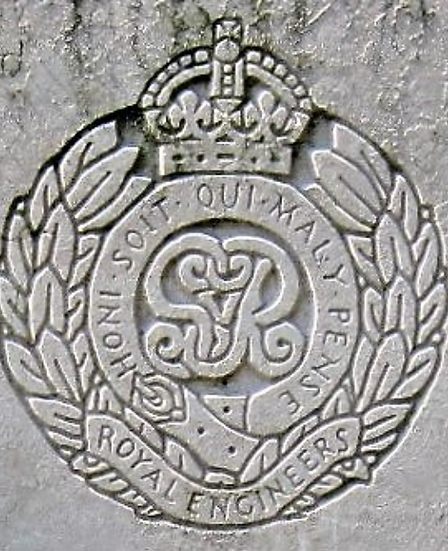
Royal Engineers Crest WW1
Charles John Hitchcock knwn as Jack was born in Hemel Hempstead, Hertfordshire in December 1888 and baptised on Sunday, 31st March 1889 in St Paul’s Church on Queen Street in the town. He was the oldest son of Charles John Hitchcock and Annie Lane who had a large family of ten children who were, Lily, Charles John, Ann, Rose, Frederick William, Stanley, Sidney Thomas, Winifred Daisy, Herbert Reginald and Nellie. Stanley died when he was just a year old in 1899 whilst Jack's brother Frederick also died in the Great War, aged twenty-five, and tragically his death came fourteen days after the Armistice was signed. Frederick’s biography is also in this book. When Jack was born his family lived on Bury Hill in Hemel Hempstead and his father Charles Snr. worked as a ‘Bricklayer’s Labourer’, but by the time Jack left school, it lived in Astley Road just off Cotteralls Road. Over the years Charles Snr. Found work as a ‘Gravedigger’ and a ‘Farm Labourer, whilst almost all of his children, including Jack went to work at John Dickinson & Co. Limited in Apsley Mills.
He started working at Dickinsons as soon as he left school in 1902 and he trained as a ‘Printer’ and it was at Apsley Mills that he met his future wife Ellen Mary Tungate Alecock who also worked there as a ‘Printer’. Ellen was a native of London and had been born in Marylebone in 1889 and baptised in St Mary’s Church, Bryanston Square in December of that year along with three of her siblings. When she and Jack met, she lived on Primrose Hill in Kings Langley and they were married at St Paul’s Church in Hemel Hempstead on Monday, 27th May 1912 , immediately setting up home on Railway Terrace in Kings Langley, not far from Ellen’s mother and close to their workplace at Dickinsons. Another couple married in St Paul’s on the same day was Alfred George Tebby and Florence Batchelor. Alfred was also killed in the war just a month after Jack and his biography is also on this site. A year after their marriage, Jack and Ellen had the first of their two children when a daughter, Ellen Mary was born on the 4th Feb 1913. Elsie Norah appeared on the 3rd June 1915 and the family was complete.
On the outbreak of war, Jack had been retained by John Dickinsons as his occupation was ‘starred’ or reserved as an essential skilled job. Following the declaration of war, many men left Dickinsons but after a number of months the firm required anyone who wished to volunteer to apply for permission, as it feared the loss of skilled men would adversely affect the business. However, in June 1916 Jack was finally permitted to join the Colours and he attested at Watford in June and was immediately posted to the Army Reserve to await call up. This came in July 1917 when he was mobilised and posted to 103rd Training Reserve Battalion for his basic training. During his medical it was noted that he had a history of heart palpitations and as a result he was categorised “B1” which was “Garrison Service Abroad”. Three months later he was transferred to 2/1st Scottish Horse Yeomanry which had been converted to a Cyclist Battalion and he went to Ladybank, Fife in Scotland. In April 1918 the 2/1st went to Ireland and Ballycannon Barracks in Limerick, in the west of the country. Shortly after arriving, Jack was transferred to the Royal Engineers and was posted to “J” Depot Company at the Curragh Camp, County Kildare to the west of Dublin.
He was granted home leave, and, on the 10th October 1918, he set off aboard the RSS Leinster to see his wife and children in Hemel Hempstead. The ship, a mail boat, set sail at 9am on a fine morning from Kingstown (Dun Laoghaire), but it had only sailed sixteen miles on its journey to Holyhead when it was attacked by a German U-boat. UB-123 fired a torpedo which missed the Leinster but scored a hit on the port side of the ship with a second missile which also blew a hole in the starboard side. The initial attack had resulted in a few casualties, but as lifeboats were being launched another torpedo struck on the starboard side, practically blowing it to pieces. The Leinster sank almost immediately, bow first.
There were 813 passengers and crew on board and 569 were lost in the sinking, the majority of which were military personnel either going on or returning from leave. They came from Ireland, Britain, Australia, New Zealand, Canada, the United States, and France. UB-123 was lost in a minefield with its entire crew while attempting to return to Germany. The sinking resulted in the greatest ever loss of life in the Irish Sea and the highest ever casualty rate on an Irish owned ship. Jack was one of the many passengers reported missing presumed drowned until seven days later his body was washed up in Kirkcudbright in southern Scotland. He was recovered and subsequently buried in the old churchyard of St Cuthbert’s in the village and details of this were published in the Hemel Gazette.
He died on Thursday, 10th October 1918.
Ellen married again following Jack's death to George Lee in Hemel Hempstead in 1921. She lived until the age of ninety-two and died in 1981.
Jack was commemorated on the John Dickinson & Co. Limited War Memorial in Apsley End where he had worked before the war. He is recorded twice on the town War Memorial as Hitchcock Charles J and Hitchcock J, the second engraving presumably requested by his parents who always knew him as 'Jack'. He is one of a number of men recorded twice on the Memorial for similar reasons.
Jack is Remembered with Honour in the Kirkcudbright (St. Cuthbert) Old Churchyard, Kirkcudbrightshire, Scotland, where he is interred in Special Plot 4
He was 30 years old when he died.
Jack was entitled to the British War Medal and the Allied Victory Medal.


