
Frank Ward
291130 Private
‘D’ Coy., 11th Bn., Norfolk Regiment
Died of Illness, Tuesday, 19th November 1918
Remembered with Honour, Kingswood (St. Andrew) Churchyard, Surrey, England, East of Church
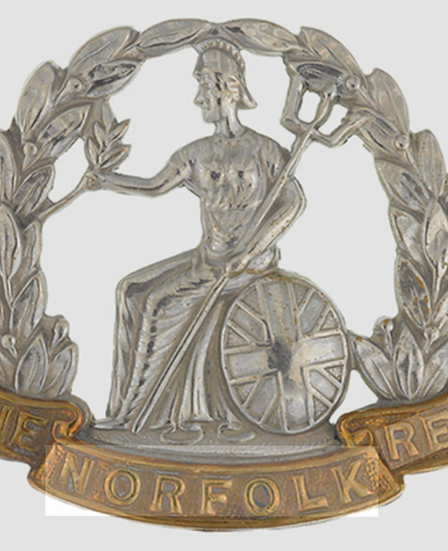
Norfolk Regiment Cap Badge WW1
Frank Samuel Ward was born in Northington, near Winchester, Hampshire in February 1875 and baptised two months later on Sunday, 4th April. He was the second of seven children born to John William Ward and Eleanor White and his siblings were, John Ernest, Leonard William, Eleanor, Daisy, Harry Bertram and Evelyn Violet. Two of his sisters died young Eleanor and Daisy. Frank’s parents were both school teachers and not long after he was born, the family moved to Banstead in Surrey and it was here that Frank and siblings were educated and grew up. When he left school in 1888, he went to work in a shop and by 1891 he was employed as a ‘Shopman’ by one Jubal Webb.
Jubal Webb was a Cheesemonger and traded from premises on Kensington High Street in London next to Barkers department store. Webb, a shameless self-promoter, was most famous for being the owner of the "Mammoth Cheese". This cheese, at six feet high and twenty-eight feet wide, was the largest cheese in the world. Made in Canada, it was exhibited at the Chicago World's Fair in 1893 and Webb purchased the cheese and brought it to London, where it was carved up in a ceremony presided over by the Canadian High Commissioner, Sir Charles Tupper. It was here that Frank learned his trade and although it is not known how long he worked for Jubal Webb, if he was still working for him in 1900, his employment would have ended when Webb’s business went into administration.
By 1905 Frank was in Hemel Hempstead where he worked and lived at 73 High Street, the Drapery store owned by William Clarke. Frank worked as a Draper’s Clerk and Cashier in Clarke’s business and was an active member of two local churches where he became the regular organist. Firstly, St John the Baptist, Great Gaddesden and secondly, St Paul’s Church on Queen Street where he also worshipped. Frank was one of the original members of the Hemel Hempstead Volunteers Company. He remained in the employ of William Clarke until he volunteered in 1915 when he was almost forty years old. He attested under the Group (Derby) Scheme at Watford on the 19th December when on the promise of future service, he was categorised “Class A” assigned to Group 23 and posted to the Army Reserve with a day’s pay.
His Group number meant that he was mobilised in March 1916 when he returned to Watford to enlist, however, rather than being sent for basic training he was once again posted to the Army Reserve. It is not clear from his surviving service records why this happened, but it is possible he was categorised “Unfit for Military Service”. This is because when he did finally enlist on the 21st May 1917, his records note he had been recategorized “A” and therefore fit to join the Army. He was posted to the 11th Battalion Norfolk Regiment and began training but only five months later in October, his Battalion received orders to disband and he was transferred to the Labour Corps and posted to 667 Agricultural Company.
This posting again suggests that Frank had issues with his fitness as the Agricultural Companies tended to be made up from enlisted men who were considered unfit for frontline combat duties. He served his time at home in England where he worked the land as there were major labour shortages due to the war and food production was vital for both the home front and the armies overseas. The global influenza pandemic, known as “Spanish Flu ”, began in January 1918, but in the UK and many other parts of the world, reached its peak between September and the end of November of that year because of a second wave and stronger strain of the virus. By August, when the second wave began in France, Sierra Leone, and the United States, the virus had mutated to a much more deadly form and October 1918 was the month with the highest fatality rate of the whole pandemic. This increased severity has been attributed to the circumstances of the First World War, primarily because severely ill soldiers were sent on crowded trains to crowded field hospitals, spreading the deadlier virus. In the UK alone, a quarter of the population were affected, some 10,500,000 million people, of which 228,000 died of the illness or its effects. This compares to 744,000 British combat deaths in the entire war.
Frank fell ill on the 3rd November 1918 and three days later was admitted to Whipps Cross Hospital, Leytonstone in London and diagnosed with influenza. He was immediately treated and three days later showed signs of slight improvement. However, he had in fact contracted Bronchopneumonia and he quickly deteriorated and died. He succumbed to the illness at 1.10 pm on Tuesday, 19th November 1918, thirteen days after being admitted to hospital and tragically eight days after the Armistice was signed ending the Great War. Frank’s body was returned to his parents at Tadworth in Surrey and he was buried at St Andrew’s Church in Kingswood on Tuesday, 26th November 1918.
He was commemorated on the original war memorial plaque in St Paul’s Church on Queen Street in Hemel Hempstead where he had been the organist before the war. The plaque was sadly lost when the church was demolished in the early 1980’s but has been replaced with a decorative scroll which is on display in the present church in Highfield, Hemel Hempstead.
Frank is Remembered with Honour in the Kingswood (St. Andrew) Churchyard, Surrey, England, where he is interred in a Grave to the East of the Church.
He was 43 years old when he died.
(Frank’s records are a little confusing in regard to his age when he died, with some of the military records stating 41 and but most others 43. I have used his birth and census records to settle his age)
Frank was entitled to the British War Medal and the Allied Victory Medal.


