
Frederick George Hawkins
63419 Serjeant
12th Bn., Suffolk Regiment
Killed in Action Saturday, 28th September 1918
Remembered with Honour, Tyne Cot Memorial, West-Vlaanderen, Belgium, Panel 40 to 41
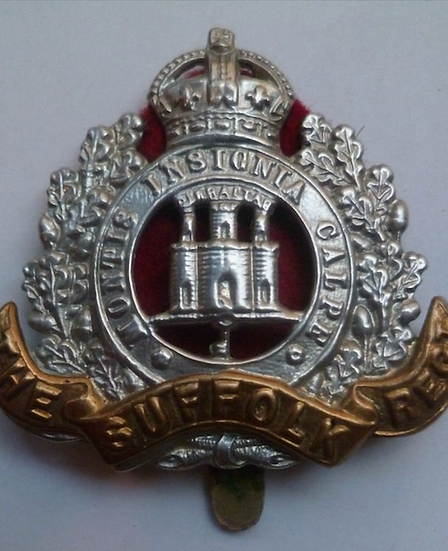
Suffolk Regiment Cap Badge WW1
Frederick George Hawkins was born in Wigginton, near Tring in Hertfordshire in 1893 the first child and oldest son of George Hawkins and Elizabeth Aves Durrant. He had one sibling, a sister, Aves Mary born two years after him. His father George brought the family to Hemel Hempstead when he came to work as a “Cattle Herdsman” for the Boxmoor Trust and in 1901 they were living in the “Herdsman’s Cottage” which was situated close to Boxmoor & Hemel Hempstead Railway station. By 1911, the family had moved to 24 St. John’s Road, Boxmoor and Frederick was working as a “Envelope Cutter” in Apsley Mills for John Dickinson & Co., Limited. His father George now a “Farm Bailiff” was recorded as an “Invalid” and his sister Aves was in secondary education at the age of sixteen.
Frederick left Dickinsons after the 1911 Census and travelled to London where he joined the Metropolitan Police on the 25th May 1914 and was allocated warrant number 103908 and his divisional or collar No. was 984S. He was posted to “S” Division based in Hampstead in No. 2 District. He served with the police until 1916 when he took the decision, as did many serving police officers, to leave and volunteer for service. He attested at Whitehall in July 1916 and was immediately posted for basic training with the 3rd Reserve Battalion Norfolk Regiment at Felixstowe before being sent overseas at the end of the year. When he went to France he was posted to the 1st Battalion Norfolks and appears to have arrived with one of a series of drafts through January 1917. The new arrivals were still considered “untrained” in battlefield conditions, so they were all dispatched to the Brigade Training Depot.
Frederick was back with the Battalion by the end of February and was soon in action in the frontline trenches and during his time with the battalion he was promoted Sergeant. It is not clear how long he stayed with the Norfolks but he transferred at some point in 1916 to the 1st Battalion Essex Regiment which had returned from Gallipoli in March of that year. It seems likely that this was a result of being wounded as the Norfolk Regiment recorded regular departures of wounded men each month throughout the year. He was transferred a second time in June 1918, this time to the 12th Battalion Suffolk Regiment and again this may have been due to being wounded. The 12th Suffolks had been reduced to cadre strength and returned to England in June 1918 to rebuild and this would have meant experienced officers, NCOs and soldiers joining the unit prior to a return to France. This happened on the 5th 1918 when the battalion landed at Boulogne under the orders of the 43rd Brigade in the 14th (Light) Division.
The Battalion moved as part of the Second Army to the Ypres sector as soon as had landed at Boulogne and would see out the rest of the war in Belgium. Frederick spent July and August training soldiers in the rebuild unit having been promoted Sergeant again and was back on the frontlines near Ypres in early September. On the 28th September Frederick fought in what became known as the Fifth Battle of Ypres when the 12th Suffolks were in support of the main attack. The Battalion War Diaries recorded the following: “Although battalions very weak and the men belonged almost entirely to “B” Category, yet they were filled with keenness and confident of success. They moved across the ground with energy keeping close to the barrage….Enemy showed some determination to hold it [position on a bluff] at first against the frontal attack, but when he perceived the encircling movement he lost heart and gave way.”
Sadly Frederick did not live to enjoy the success of the action and it was later reported that he had been killed at 6 a.m. only half-an-hour into the battle.
He was killed in action on Saturday, 28th September 1918.
He was commemorated on the Metropolitan Police Book of Remembrance in Westminster Abbey and on the War Memorial Plaque in the Church of St. John the Evangelist in Boxmoor, where he and his family had worshipped.
He is Remembered with Honour on Tyne Cot Memorial, West-Vlaanderen, Belgium on Panel 40 to 41.
He was 25 years old when he died.
Frederick was entitled to the British War Medal and the Allied Victory Medal.


