
Isaac Sproat
WR/266488 Lance Corporal
18th Wagon Erecting Coy., Royal Engineers
Died of Illness, Saturday, 16th November 1918
Remembered with Honour, Les Baraques Military Cemetery, Sangatte, Pas de Calais, France, Grave VI. G. 13A.
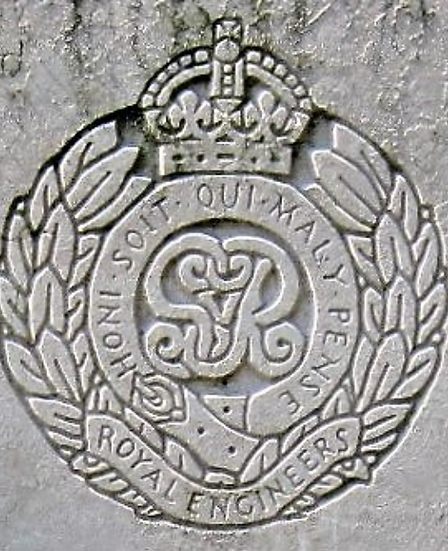
Royal Engineers Regimental Crest WW1
Isaac Sproat was born on Wednesday, 22nd June 1887 in Brayton railway station, near Aspatria, Wigton, Cumberland (Cumbria) just to the north of the Lake District. He was the second and youngest child born to Thomas Sproat and Elizabeth Patterson and his older sibling was Joseph George. His father Thomas was the Station Master at Brayton on the Maryport and Carlisle Railway who tragically died as the result of a shunting accident on the 12th September 1911. The investigation and report into his death by the Railway Inspectorate reported the following: “At 8.15 am he had released the brakes on four wagons standing on a loading bank to move them by gravity. He was caught between one of the wagons and the bank and died of his injuries”. Thomas was sixty-one years old. His wife Elizabeth had Thomas interred in the Churchyard of Middlebie church near her birthplace in Kirkpatrick, Dumfriesshire and she joined him there in 1932 when she died aged eighty-six. Isaac went to school in 1893 and attended the Board School in Aspatria before entering the newly created Nelson School for Boys in January 1899. Nelson School was a grammar school originally founded in 1714 as Wigton Grammar School and stands in the same location in the town today as The Nelson Tomlinson School. One famous alumnus was Melvyn Bragg the writer and broadcaster.
When Isaac completed his education in 1903, he like his father and brother joined the railways. He started work on the 14th April 1903 in the Audit Department of the Coaching Division of the London and North Western Railway (LNWR), an ancestor of today’s West Coast Mainline. He was a Junior Clerk and stayed at Armathwaite for four years before moving briefly to the LNWR headquarters at Euston station in London. Six months later he moved back to the Coaching Division this time in Watford and by 1911 both he and his brother George were boarding together at the home of Frederick Boxall at 62 Market Street in Watford and both recorded as Clerks.
Around this time, Isaac met his future wife Agnes Mary Sygrove who was born in 1887 in nearby Bushey. Agnes worked as a 'Shop Assistant' in a Hairdressers and the couple married on Saturday, 6th June 1914 at Bushey & Oxhey Methodist Church just two months before the outbreak of war. By the time of his marriage Isaac was living in Boxmoor, Hertfordshire close to the railway station where he was working. Agnes joined him and they moved into a house at 11 Sebright Road where they were together for only a few months before Isaac volunteered.
Isaac attested at the start of 1915 and enlisted with the Army Service Corps (ASC) where his experience on the railways could be put to best use. The men of the ASC were the unsung heroes of the British Army in the Great War. Soldiers could not fight without food, equipment and ammunition nor could they move without horses or vehicles. It was the job of the ASC to provide these and the vast majority of supply to maintain the armies on many fronts, came from Britain. The ASC used horses and motor vehicles, railways and waterways, and performed prodigious feats of logistics which was one of the great strengths of organisation which ensured the war was won.
He was posted to one of the two Railway Labour Companies to train and in December 1915 he went overseas disembarking in France on the 21st of the month. He was then sent to one of the detachments of ‘Special Supply’ of which there were five in France at bases in Le Havre, Bailleul, Steenwerck, Caestre and Strazeele. At some point during the conflict, Isaac transferred to a specialist Railway Operating Division and was posted to the 18th Wagon Erecting Company where his duties involved constructing, repairing and maintaining the train rolling stock. He spent the whole of the war involved in this vital work and seemed sure to return to England as the war drew to a conclusion.
However, throughout 1918 the worldwide influenza epidemic or ‘Spanish Flu’ was wreaking havoc and the armies of both the Axis and the Allies were no exception. It appears that having survived to see the war end in victory for the Allies with the signing of the Armistice, Isaac was preparing to return home when he was struck down with ‘Spanish Flu’. This resulted in complications and he contracted Bronchopneumonia, a bacterial form of the disease often associated with slower acting forms of the flu virus.
He was admitted to 35 General Hospital, one of five serving Calais in France, where sadly he succumbed to his illness just five days after the end of the Great War.
Isaac died on Saturday, 16th November 1918.
Throughout his time in France, Isaac sent back beautiful embroidered cards to Agnes as tokens of his love. Agnes and Isaac had no children together and many years later she passed the cards that he had sent to one of her great nieces. Agnes did not remarry after Isaac’s death and she passed away in Hove, East Sussex in 1977 at the age of ninety. He was commemorated on a number of memorials in Watford, Boxmoor and the Audit Office Euston Station London war memorial the last of which is now held at the National Memorial Arboretum in Staffordshire. In Watford he was included on the Borough Memorial and on the War Memorial plaque in Bushey & Oxhey Methodist Church.
Isaac is Remembered with Honour in the Les Baraques Military Cemetery, Sangatte, Pas de Calais, France, Grave VI. G. 13A. The inscription on his headstone, requested by his wife Agnes, reads “UNTIL THE DAY BREAK”.
He was 31 years old when he died.
Isaac was entitled to the 1914-15 Star, the British War Medal and the Allied Victory Medal.


