
Percy George Smith
101467 Sapper
247th Field Coy., Royal Engineers
Killed in Action Monday, 30th September 1918
Remembered with Honour, Cantaing British Cemetery, Nord, France, Grave E. 4.
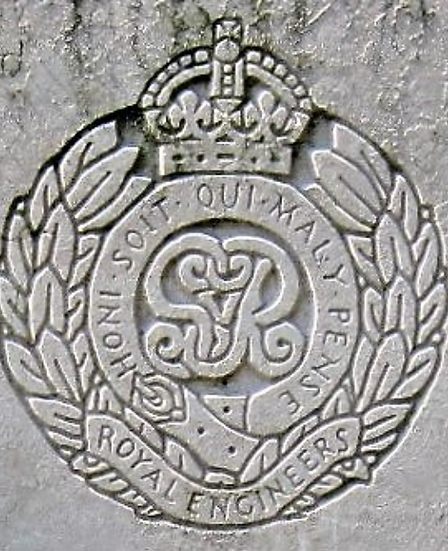
Royal Engineers Regimental Crest WW1
Percy George Smith was born on Monday, 17th July 1893 in Paradise, Hemel Hempstead and baptised exactly two months later on Sunday, 17th September at St. John the Evangelist Church, Boxmoor. He was the eighth child and youngest son of William Smith and Emily Eliza Haynes who had a total of nine children together. Percy’s siblings were William Frederick, Richard Charles, Lucy Emily, Nellie Elizabeth, Sidney Archibald, Gertrude Alice, Clara Frances, Percy George and Constance Mary. Richard died in 1900 aged twenty-three and Percy’s father William died on the 10th February 1911 at the age of sixty-one. Lucy died in 1915 aged thirty-six and tragically Gertrude died from “Spanish Flu” just a month after Percy in October 1918 aged thirty.
Percy’s father William was a native of Hemel Hempstead who worked as a “Chemists Assistant” and was a trained “Drug Dispenser”. He had however, travelled extensively across the English Midlands whilst training and to take up various positions and as a result he met and married Emily Eliza Haynes in Leamington Spa in 1875. They then moved to Bridgnorth in Shropshire followed by Peckham in London before returning to settle in Hemel Hempstead. Percy started his education at Boxmoor JMI School to which he was admitted on the 1st February 1899 aged five and by the time he left he had achieved four of the seven “Standards”.
In 1901 the family was living in the area of the town known as “Paradise” and the three oldest children were all working. Young Percy left school on the 9th November 1906 and went straight to work as a “Telegraph Boy” but two years later, he started an apprenticeship as a “Gas Fitter”. He was indentured to Mr. Charles Hildesley who ran his gas fitting business from 83 High Street, which was situated on the other side of the alley from the Sun Inn. During this time, Percy sang in the Church Choir at St. John the Evangelist in Boxmoor as well as taking an active part in the Borough Choral Society. He was also a member of the Church of England Men’s Society (C.E.M.S.) which had grown in popularity with young men directly before and during the early part of the Great War. Percy completed his apprenticeship in early 1915 and immediately asked for his employer’s permission to leave so that he could volunteer for service. He has already joined the local Special Constabulary and indeed was one of the first to enlist when it had been established after the outbreak of war.
On Tuesday, 25th May 1915, he attested at Hemel Hempstead and enlisted with the Royal Engineer’s (RE) so that his mechanical and engineering skills as a Gas Fitter could be put to best use. He was immediately posted to Chatham to undergo the RE training course and was sent to France early in 1916 and posted to the 247th Field Company RE. The 247th was one of three field companies raised for the Royal Naval Division and came under the orders of the 63rd (Royal Naval) Division. It had taken part in the Gallipoli campaign in 1915 but returned to France in May 1916 and it was there that Percy joined his new unit. He saw his first serious action when he fought in the Battle of Ancre during the closing phase of the Somme Offensive in November 1916.
In February 1917 the 247th transferred to the Corps of Royal Engineers and was redesignated. Percy fought through the Arras Offensive and was in action in the Third Battle of Ypres at Passchendaele in November and finished the year fighting at Welsh Ridge on the 30th December. The 247th were again in action at the First and Second Battles of the Somme in 1918 and during the “final push” from August onwards. It was in late September that Percy was at Cantaing and had just returned to the camp following work on a nearby bridge. The Company War Diaries recorded an incident as follows: “…the camp at F28d63 was shelled and 1 OR was killed and 3 OR were wounded…”. Sadly, Percy was the man killed by the shelling.
He died on Monday, 30th September 1918.
He had been in France and Belgium for almost three years when he was killed and not only fought through significant actions, but carried out his duties as a Sapper almost always near the front lines and certainly within range of enemy artillery and sniping. The war relied on engineering and without engineers there would have been no supply to the armies, because the RE’s maintained the railways, roads, water supply, bridges and transport. RE’s also operated the railways and inland waterways. There would have been no communications, because the RE’s maintained the telephones, wireless and other signalling equipment. There would have been little cover for the infantry and no positions for the artillery, because the RE’s designed and built the front-line fortifications. It fell to the technically skilled RE’s to develop responses to chemical and underground warfare. And finally, without the RE’s the infantry and artillery would have soon been powerless, as they maintained the guns and other weapons. Little wonder that the Royal Engineers grew into a large and complex organisation numbering some 315,000 by the end of the war.
A brief obituary was published in the Hemel Gazette shortly after he had been killed.
He was commemorated on the War Memorial Plaque in the Church of St. John the Evangelist in Boxmoor where he had worshiped and sung before going to war.
Percy is Remembered with Honour in Cantaing British Cemetery, Nord, France, where he is interred in Grave E. 4.
He was 25 years old when he died.
Percy was entitled to the British War Medal and the Allied Victory Medal.


